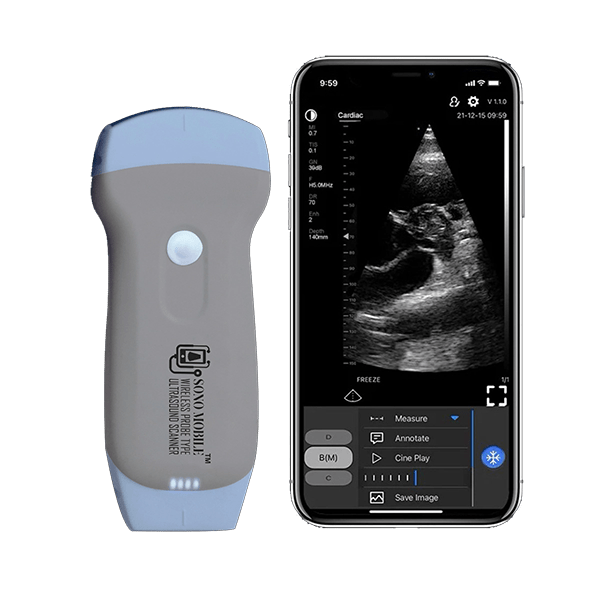
Access to diagnostic imaging has traditionally depended on location. Hospitals and large medical centers may have radiology departments, dedicated ultrasound systems, experienced sonographers, and specialist interpretation readily available, while smaller clinics, rural facilities, mobile medical teams, and remote communities often work with more limited resources.
The development of compact ultrasound technology is gradually changing this model. Instead of requiring every patient to reach a dedicated imaging department for an initial assessment, clinicians can now bring selected imaging capabilities directly to the patient.
This does not mean comprehensive diagnostic ultrasound is becoming unnecessary. Rather, handheld systems are creating another level of imaging access: focused examinations performed close to the point of care to answer specific clinical questions, guide procedures, support triage, and determine when more advanced imaging is required.
Why Access to Diagnostic Imaging Still Matters
Imaging can influence decisions across almost every area of medicine, but access is not always immediate.
A patient in a major hospital may be able to undergo formal ultrasound, CT, MRI, or echocardiography relatively quickly. The situation can be very different in a rural clinic, ambulance, community health center, or facility without continuous radiology coverage.
Delays may result from:
- Distance from imaging facilities
- Limited specialist availability
- Transportation requirements
- High demand for imaging services
- Lack of suitable equipment
- Difficulty moving unstable patients
Portable ultrasound can help fill part of this gap because it can be performed where the patient is already receiving care.
The American Institute of Ultrasound in Medicine describes point-of-care ultrasound as portable imaging performed at the bedside to support immediate assessment and treatment decisions.
Bringing Imaging Into the Clinical Examination
One of the most important changes created by compact ultrasound is the integration of imaging into the clinical encounter.
A traditional diagnostic pathway may involve examining the patient, requesting imaging, transferring or scheduling the patient, obtaining the study, and then reviewing the results.
With focused bedside ultrasound, clinicians can sometimes investigate a specific question during the original assessment.
For example, they may ask:
- Is there free fluid in the abdomen?
- Is the bladder significantly distended?
- Is a pleural effusion present?
- Is lung sliding visible?
- Is there an appropriate vessel for vascular access?
- Is gross cardiac function severely reduced?
These questions are narrower than those answered by comprehensive diagnostic studies. That distinction is important. AIUM guidance emphasizes that point-of-care ultrasound is complementary to the physical examination and that additional or comprehensive imaging may still be necessary.
Expanding Imaging Beyond Large Hospitals
The accessibility of Handheld Ultrasound can be particularly important in healthcare environments where a conventional ultrasound system may not always be practical.
Compact devices can potentially be used in:
- Small outpatient clinics
- Rural health centers
- Emergency departments
- Intensive care units
- Ambulances
- Mobile clinics
- Disaster-response environments
- Community healthcare programs
The World Health Organization has documented the use of portable POCUS in Samoa, where rural and district facilities may face limited access to formal imaging. There, training programs have supported applications in emergency care, dialysis services, and rural clinics.
This illustrates an important point: the value of handheld imaging is not simply that the device is small. Its value is that imaging capability can reach environments where access would otherwise be delayed or unavailable.
Supporting Primary Care Decisions
Portable ultrasound is also attracting interest in primary care.
General practitioners regularly evaluate abdominal discomfort, urinary symptoms, dyspnea, soft-tissue abnormalities, musculoskeletal complaints, and other conditions where focused ultrasound findings may contribute to the clinical assessment.
A 2025 review of POCUS in primary care described it as a real-time, non-invasive approach that can enhance diagnostic assessment and support greater clinical autonomy when appropriately implemented.
The benefit is not necessarily making a definitive diagnosis during every visit. Sometimes the greatest value is deciding what should happen next.
A focused scan may support a decision to:
- Continue outpatient evaluation
- Request formal imaging
- Refer to a specialist
- Send the patient to an emergency department
- Perform a procedure with ultrasound guidance
In this way, handheld imaging may function as a bridge between the physical examination and comprehensive diagnostic testing.
Improving Access to Procedure Guidance
Diagnostic access is only one side of portable ultrasound. Image guidance can also make selected procedures more accessible.
Clinicians may use ultrasound during:
- Peripheral intravenous access
- Central venous access
- Thoracentesis
- Paracentesis
- Regional anesthesia
- Drainage procedures
Real-time visualization can help identify vessels, fluid collections, anatomical boundaries, and needle position.
This is particularly useful when conventional landmarks are difficult because of obesity, edema, altered anatomy, or previous procedures.
However, portability should never be confused with simplicity. Ultrasound-guided procedures require knowledge of anatomy, sterile technique, probe orientation, needle visualization, and potential complications.
Reducing the Need to Move Vulnerable Patients
Another advantage of handheld imaging is the ability to bring the examination to patients who may be difficult to transport.
Critically ill patients may depend on:
- Mechanical ventilation
- Hemodynamic monitoring
- Intravenous infusions
- Multiple catheters
- Continuous clinical observation
Transporting these patients to another department can require significant coordination.
Bedside ultrasound allows selected clinical questions to be investigated without moving the patient. This can be useful in intensive care and emergency medicine, especially when serial reassessment is required.
The examination can also be repeated after an intervention, giving clinicians an opportunity to assess changes over time.
Handheld Does Not Mean Comprehensive
As portable devices become increasingly capable, one of the most important clinical principles is understanding their limitations.
Handheld ultrasound should not automatically be considered equivalent to a comprehensive examination performed using advanced systems and specialist expertise.
Limitations may involve:
- Image quality in technically difficult patients
- Available transducer frequencies
- Doppler capability
- Screen size
- Advanced measurements
- Documentation options
- Specialized imaging modes
A limited bedside examination may answer one question while leaving several others unresolved.
If findings are abnormal, uncertain, technically inadequate, or inconsistent with the clinical picture, additional imaging should be obtained.
Training Determines Clinical Value
Making ultrasound equipment more accessible does not automatically make reliable ultrasound examinations more accessible.
Operator competence remains essential.
Healthcare organizations introducing handheld ultrasound should define:
- Who may perform examinations
- Which applications are included
- Required training
- Supervised scanning
- Competency assessment
- Documentation procedures
- Image storage
- Quality assurance
- Referral pathways
AIUM specifically notes that the institutional use of POCUS should depend on access to appropriate equipment and trained personnel and should be supported by organized quality assurance.
This infrastructure is what converts a portable device into a clinically useful service.
Connectivity May Expand Access Further
Connectivity may further increase the value of handheld ultrasound.
Images can potentially be stored, reviewed, and shared with appropriately authorized colleagues. In selected programs, remote consultation may allow clinicians in smaller facilities to obtain specialist input without requiring the specialist to be physically present.
Combined with telemedicine, portable ultrasound could become part of a distributed diagnostic model in which image acquisition and expert interpretation do not always occur in the same location.
Data protection, cybersecurity, patient identification, and documentation must still be addressed carefully.
A New Layer of Diagnostic Access
The most realistic future for handheld ultrasound is not the replacement of conventional radiology.
Instead, healthcare may increasingly operate with multiple layers of imaging.
Comprehensive radiology and specialty ultrasound will continue to provide detailed diagnostic examinations. At the same time, portable devices can give clinicians access to focused imaging earlier in the patient journey.
That earlier access may help identify urgent problems, guide procedures, prioritize referrals, and determine which patients require advanced imaging.
Conclusion
Handheld ultrasound is expanding access to diagnostic imaging by allowing selected examinations to move beyond traditional imaging departments and closer to the patient.
Its greatest value appears in situations where clinicians need focused information quickly or where comprehensive imaging is difficult to access.
The technology does not eliminate the need for formal ultrasound, radiology expertise, or advanced imaging. Its role is complementary.
When supported by appropriate training, quality assurance, documentation, and clear escalation pathways, handheld ultrasound can extend the reach of medical imaging and help more clinicians obtain useful diagnostic information at the point where care is being delivered.
- ۰ ۰
- ۰ نظر



 خرید فیلترپرس صنعتی + معرفی شرکت
 خرید کفپوش پژو 207 (هاچبک و صندوقدار) + لیست قیمت
![پولیش ماشین برای سینک ظرفشویی [نحوه استفاده + نکات مهم]](https://cdn.imgurl.ir/uploads/b147918_New_Project_47.jpg "پولیش ماشین برای سینک ظرفشویی [نحوه استفاده + نکات مهم]") پولیش ماشین برای سینک ظرفشویی [نحوه استفاده + نکات مهم]
پولیش ماشین برای سینک ظرفشویی [نحوه استفاده + نکات مهم] مقاومت کامپوزیت دندان | استحکام کامپوزیت بر اثر ضربه
 واردات از چین به ایران - معرفی شرکت حمل و نقل بین المللی
 برای سرویس بهداشتی کوچک چه روشویی مناسب است؟ راهنمای انتخاب مدل کم جا
/139624430-56a75c643df78cf77294fd37.jpg "7 کاربرد اساسی پلایی وود") 7 کاربرد اساسی پلایی وود
7 کاربرد اساسی پلایی وود/https://www.thestar.com/content/dam/thestar/news/world/2013/09/02/devils_breath_could_be_worlds_scariest_drug/angels_trumpets.jpg "نفس شیطان: ترسناک ترین ماده مخدر دنیا!! سریال قورباغه حقیقت دارد!") نفس شیطان: ترسناک ترین ماده مخدر دنیا!! سریال قورباغه حقیقت دارد!
نفس شیطان: ترسناک ترین ماده مخدر دنیا!! سریال قورباغه حقیقت دارد! آیفون 11 پرومکس یا سامسونگ گلکسی نوت 10 پلاس؟ | طراحی |
 انواع چمن مصنوعی به همراه نکات طلایی!
 آلزایمر چیست؟ علائم و روش های درمان الزایمر سالمندان
 ذات الریه چیست و چه علائمی دارد؟